
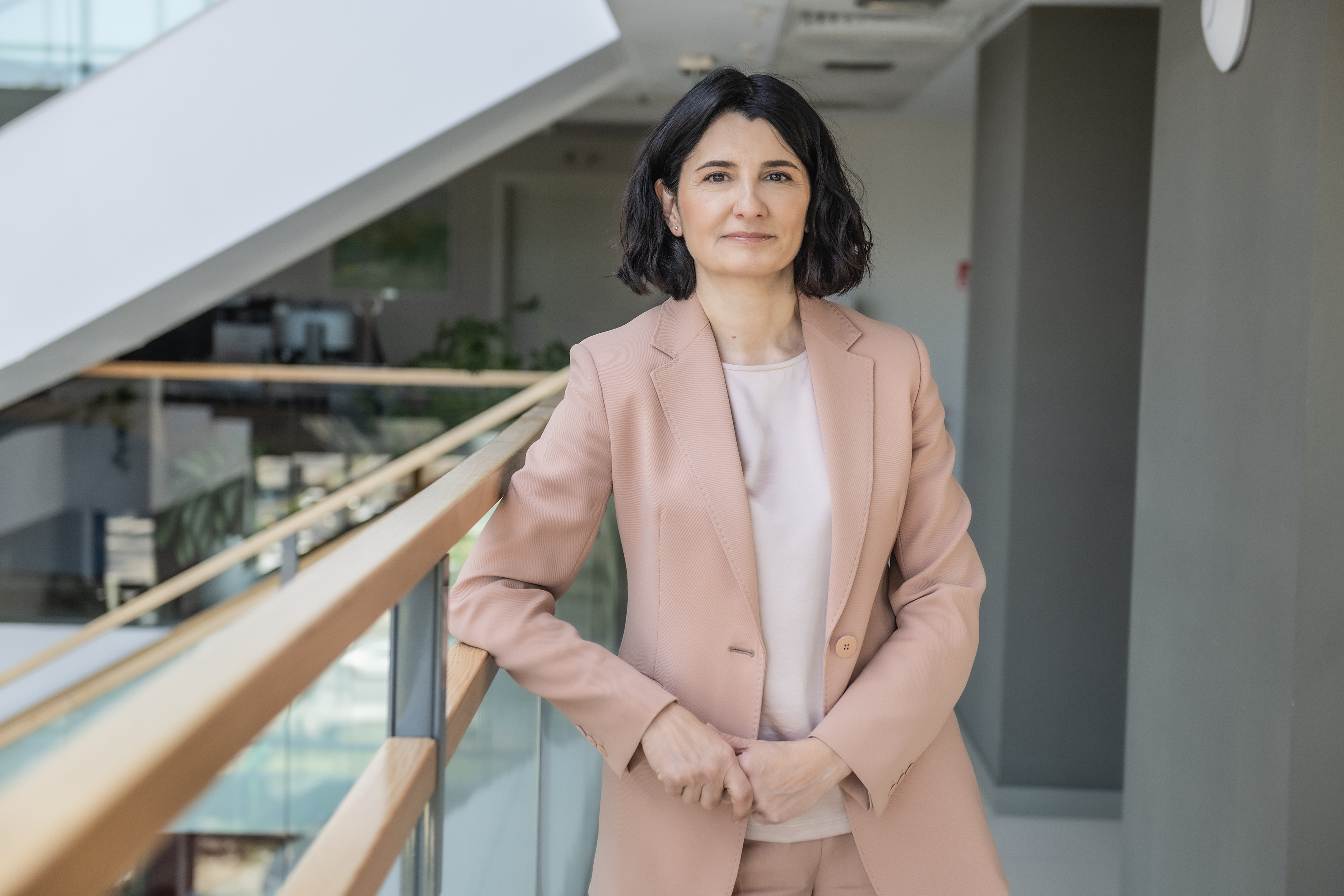
Reni Peycheva, who brings together business acumen and the analytical mind of the IT professionals
Reni Peycheva is not the kind of person who waits for change to become convenient. She has an almost impatient sense that everything can be made even better, faster, and clearer.
She has been with ProCredit Bank since 2001, right from its founding, and today she is an executive director and member of the Management Board.
When, at one point, she had to shift from the Business division to take charge of the IT department at ProCredit Bank, she simply did it.
She didn’t hide behind the title; instead, she did the hard part: she started learning.
The occasion for our meeting with Reni Peycheva is ProCredit’s 25th anniversary in Bulgaria, but our conversation with her is much more about people and the future than about money and finance.
Does digitisation change the DNA of an institution, such as a bank, in any way?
It changes it a lot. First, it changes the people who work at the institution.
To function in a digital environment, you have to change your way of thinking - in short, think outside the box, beyond the norm, sometimes even boldly, with a desire for constant change.
Not everyone is ready to accept this. Some people like working with paper, while others prefer innovation and technology.
The same applies to customers. Not every customer would feel at home in an institution that operates entirely digitally.
Internal processes are also changing. They’re becoming quite automated, perhaps that’s the best part. However, this also brings a multitude of systems into play, and one must be able to work with technology.
What were the main stages of change at ProCredit Bank?
When it came to digitalisation, the first step was deciding that we wanted to move in that direction.
That was a difficult decision for a traditional bank, where a lot of work was done on paper and where there was a strong sense of connection and emotion toward customers.
We had to figure out how to approach digitalisation in a way that preserved the bank’s human touch. We wanted to maintain our connection with customers. There was a long period of adapting the business model itself.
We went through a phase of internal persuasion so that our colleagues could embrace the idea of shifting our profile from a traditional bank to a more digital one.
We had to let go of some old ways of thinking and adopt new ones.
This was a process of continuous training and building on people’s knowledge, which is quite a serious undertaking.
The same applies to customers. We also have to work very closely with them.
Now we’re in a new situation - technology is advancing so rapidly that we have to strike a very delicate balance between the opportunities the market offers, the expectations of customers and bank employees, and the desire to be understandable rather than complicated.
The question is where and when to say “No”, isn’t it?
There are some things we really do say no to. It is extremely important to us that all innovations be simple and easy to understand. They shouldn’t complicate the customer’s interactions with the Bank or detract from the user experience. We believe that by adding more and more features, we risk reaching a point where the customer will start to get lost.
The user wants to log into a single platform and get their business done in two minutes, not get lost navigating through menus and buttons.
How many paths to digitisation are there? Does the same process look the same on paper as it does when done digitally?
This is one of the first and most important decisions, as well as one of the stages - a company goes through when it embarks on the path to digitisation.
You have to decide what everything will look like - do you want to keep it as it is or digitise it? What percentage of it do you want to digitise? What percentage of customers do you want to cover? These are tough decisions and lead to very serious discussions.
If you simply digitise the current process and just replace paper with digital documents, this often doesn’t work, and customers experience delays and clunkiness. The point of digitization is to simplify the steps, eliminate the unnecessary throughout the entire process of each operation, and automate them. The less human intervention there is—the more everyone, including those within the Bank, will feel the speed and ease of the process. At the same time, we must acknowledge that this is difficult for banks, not only because we are one of the most heavily regulated industries, but also because we strive to maintain the highest level of security at all times.
Years of experience have taught us valuable lessons, and today our recipe for successful digitization is:
- Start with a core process;
- Digitise the part of it that is most frequently used by customers and the team;
- Take the time to observe what needs to be changed and solicit feedback from all participants in the process—both customers and the team.
Do IT people speak the language of business? And do your colleagues in the business side understand those in IT? Do we need someone to translate?
This is perhaps the biggest challenge and the greatest difficulty for everyone working in the IT sector.
When it comes to internal communication within an IT company, there are no issues. Everyone speaks the same language. The question is how to make that language the customer’s language as well. That’s often where things fall apart. That’s why there are IT solutions that never become good market products but simply remain at the “application” level.
At the bank, the situation is different. You have a business that aims to reach a broad customer base and meet the needs of those people.
On the other side are the IT specialists, who see themselves as service providers and know, from a technological standpoint, what needs to be done.
Until about five years ago, our business departments and IT team spoke different languages. We changed that by combining the expertise of both teams—colleagues from the business departments moved over to the technology side, and everyone worked together on innovations. This helped bring the two cultures closer together.
In addition, some of our IT specialists underwent extensive training on customer experience, perception, and mindset—how to change the way we think, and how to make the product user-friendly.
The managers of our business departments participate in planning IT tasks.
Now they understand each other much better. It may not be perfect. There is still a long way to go in this direction, but I believe it is the right one.
Has AI changed the landscape of security in the banking sector? Are cyberattacks becoming almost a matter of state policy in the context of regional conflicts?
Both in Bulgaria and globally, there are constant attacks of all kinds.
The most common are phishing attacks. They happen daily and cause no small number of problems.
The latest trend is ransomware attacks. There have already been several reports in the media about such breaches targeting various large companies. (Note: Hackers infiltrate through an infected link or a software flaw, lock your files via encryption, and demand a ransom in cryptocurrency to restore your access to them).
Customer security is a priority not only for banks but for every institution. It requires a lot of resources, a lot of money, a lot of technology, but also a lot of thought and information.
There are various monitoring platforms that are also based on AI. Everyone must be able to choose which one actually works and which one offers the highest level of security.
At the same time, a balance must be found, because the more steps are introduced to ensure greater security for customers, the more complicated they find the process they must go through to complete a transaction.
This year, ProCredit Bank Bulgaria turns 25 years, and you are part of this milestone anniversary. How far into the future do you look?
In terms of technology, we usually look five years ahead. I don’t dare to think any further ahead, because with the pace of technological development, I think even five years is a long time. Something new comes out every day.
Over the 25 years the bank has existed, there have been so many changes—changes I’m sure very few banks have undergone in that time.
We’ve gone through transformations, explored ideas, and tried different things. We’re not afraid to experiment—and that’s a great strength of this bank.
We’re looking for new ways to improve as we move forward together with our customers.
Over time at ProCredit Bank, we’ve come to understand that quality service lies in the right combination of customer proximity, a human touch, and innovation, delivered with confidence and simplicity.
At the same time, 25 years is not enough, because I would have liked to have another 25–30 years to experiment and make things even better.